How Many Amps Does A Microwave Use: Easy Power Guide
Most household microwaves use about 5 to 15 amps, depending on their input wattage and the home’s voltage.
Knowing how many amps a microwave uses helps you choose the right outlet, avoid breaker trips, and use the appliance safely. The number on the front of the microwave shows cooking power, but the electrical power it draws can be higher. This guide explains the math, typical amp ranges, circuit needs, and simple ways to check your own microwave.
How Many Amps Does a Microwave Use?
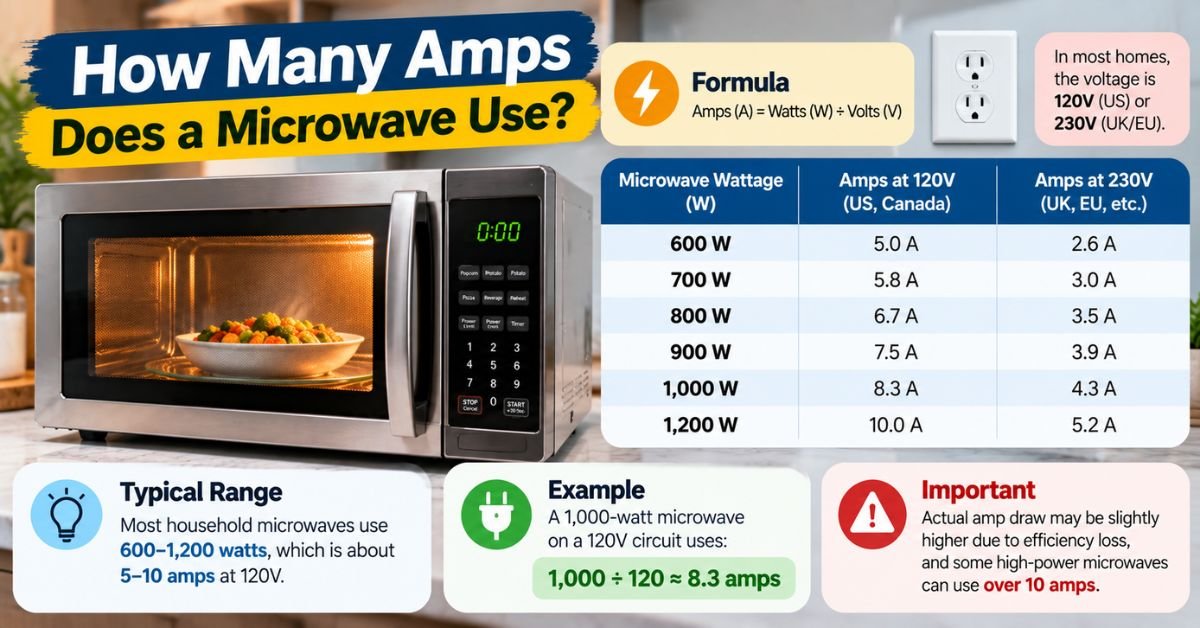
Most countertop microwaves in the United States use between 5 and 15 amps during normal operation. A small 600-watt model may draw about 8 amps, while a larger 1,200-watt model may draw 12 to 15 amps.
The exact number depends on the microwave’s input wattage and your home’s voltage. In the US, most kitchen outlets supply about 120 volts.
Use this basic formula:
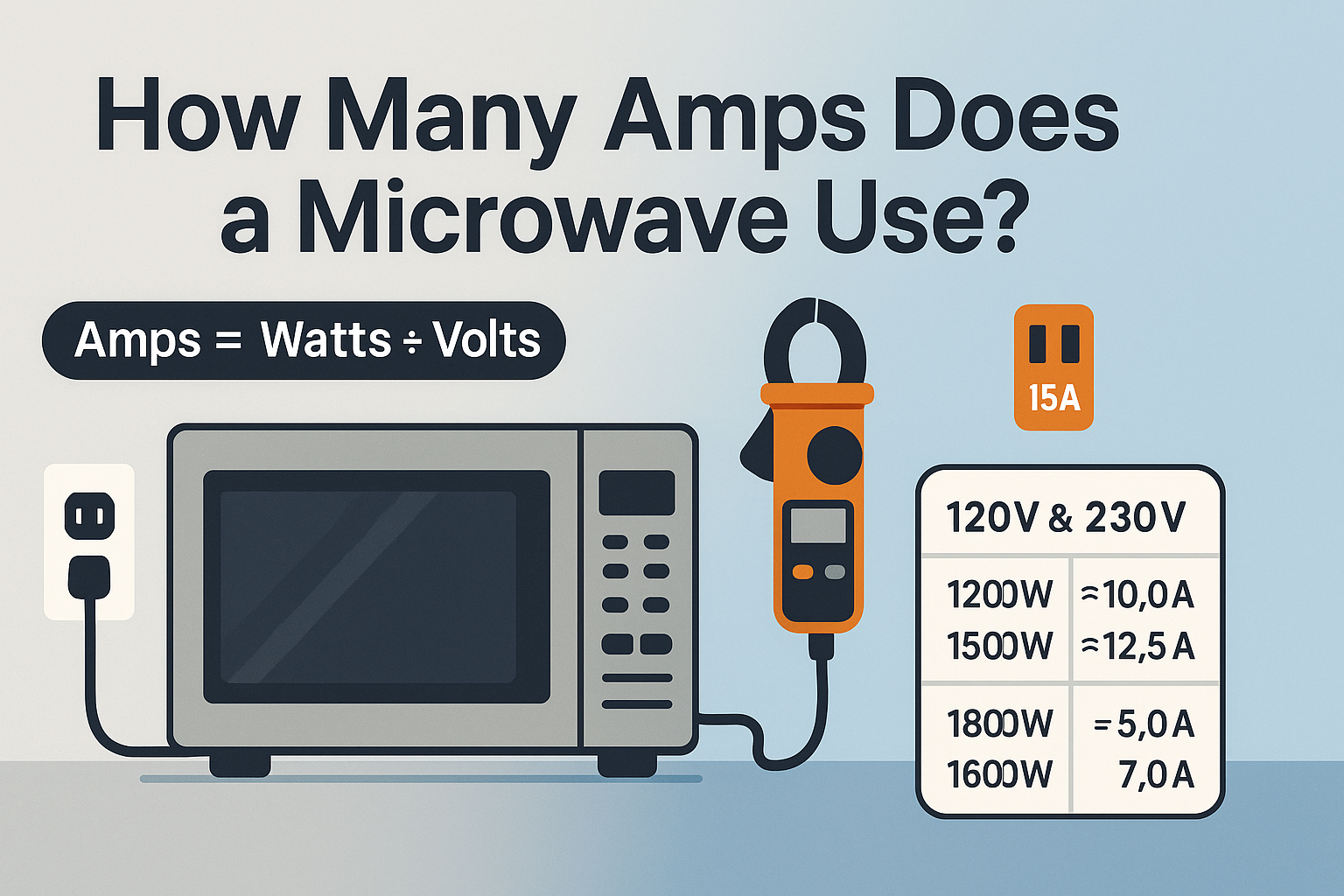
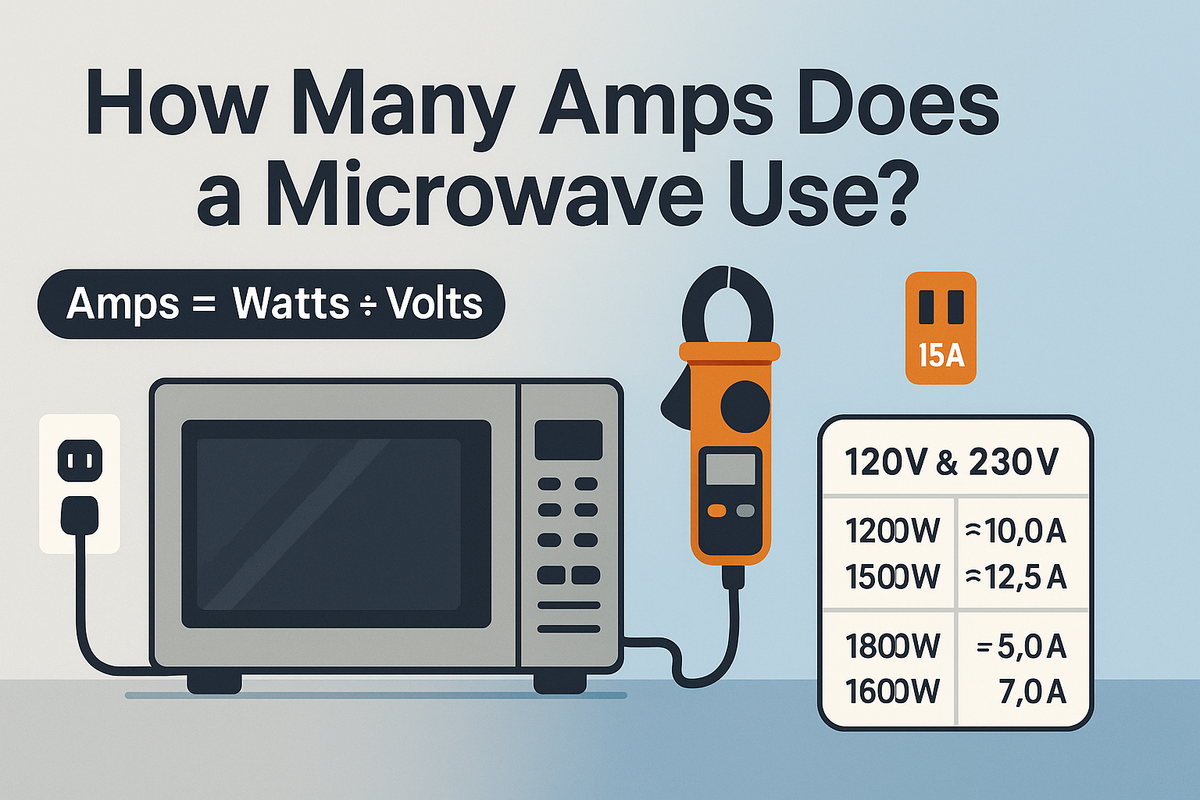
Amps = Watts ÷ Volts
For example, a microwave that uses 1,200 watts on a 120-volt outlet draws:
1,200 ÷ 120 = 10 amps
This calculation gives a close estimate. The rating plate on the microwave gives the most reliable number because it accounts for the full electrical load.
A microwave may also draw a little more power than its label suggests during certain operating periods. Still, the normal running current is the number that matters most when checking circuit capacity.
Source: udpwr.com
Microwave Amp Usage by Wattage
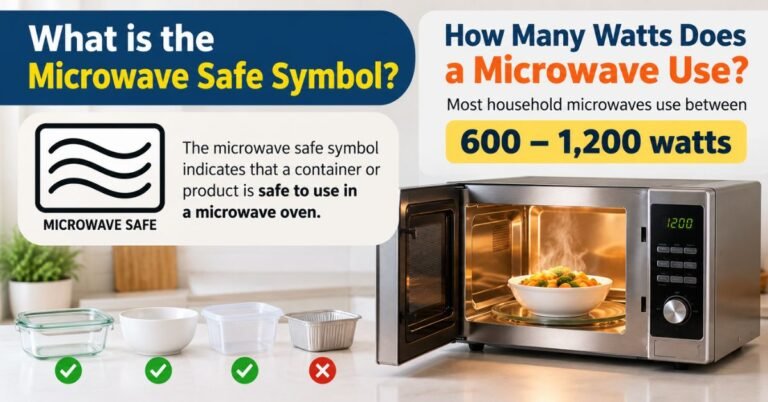
Microwave wattage often refers to cooking output, not total electrical input. This difference can confuse shoppers and homeowners.
A microwave may cook with 1,000 watts but use 1,400 watts from the outlet. The extra power runs the magnetron, fan, light, turntable motor, control board, and other parts.
Here is a general guide for a 120-volt US outlet:
| Microwave cooking power | Approximate input power | Estimated current |
|---|---|---|
| 600 watts | 900 watts | 7.5 amps |
| 700 watts | 1,000 watts | 8.3 amps |
| 900 watts | 1,300 watts | 10.8 amps |
| 1,000 watts | 1,500 watts | 12.5 amps |
| 1,200 watts | 1,700 watts | 14.2 amps |
These figures are estimates. Always check the label near the door frame, on the back, or inside the owner’s manual.
A compact microwave may use 6 to 9 amps. A full-size family microwave may use 10 to 15 amps. Over-the-range models can use a similar amount for microwave heating, although the exhaust fan and cooktop lights add other electrical loads.
When people ask how many amps a microwave uses, they often look only at the cooking wattage. Checking input wattage gives a much safer and more accurate answer.
 calculate Microwave Amps”
style=”max-width: 100%; height: auto; border: 2px solid black; border-radius: 10px; display: block; margin: 0 auto;”
loading=”lazy”
/>
Source: udpwr.com
How to calculate Microwave Amps
You can calculate microwave amperage in three simple steps.
- Find the input wattage on the microwave label.
- Find the voltage supplied by the outlet.
- Divide watts by volts.
For example, imagine the label says:
• Input power: 1,500 watts
• Voltage: 120 volts
The calculation is:
1,500 ÷ 120 = 12.5 amps
So, that microwave uses about 12.5 amps while running.
Some labels list volts and amps instead of watts. If the label says 12.5 amps, you do not need to calculate anything. That number is the appliance’s rated current.
If you live outside the United States, the result may differ because household voltage varies. For example, a 1,500-watt microwave on a 230-volt supply uses about 6.5 amps:
1,500 ÷ 230 = 6.5 amps
The microwave may use fewer amps at a higher voltage while still using similar power. This is why voltage must always be part of the calculation.
A practical lesson from checking appliance labels is simple: do not guess from the cooking wattage alone. The input rating is the number to use when you plan a circuit or troubleshoot a breaker.
Source: udpwr.com
Does a Microwave Need a 15-Amp or 20-Amp Circuit?
Many microwaves work on a 15-amp circuit, but a 20-amp circuit may be a better choice for larger models or shared kitchen loads. The correct setup depends on the microwave’s input rating, the circuit wiring, and local electrical rules.
A microwave rated at 12.5 amps can operate on a 15-amp circuit under normal conditions. However, little capacity remains for other appliances on the same circuit.
For example, a microwave and toaster may each use more than 10 amps. Running both at the same time can overload a 15-amp circuit and trip the breaker.
Keep these points in mind:
• A 15-amp circuit should not be treated as a full 15 amps for continuous use.
• A 20-amp circuit provides more usable capacity.
• The breaker, wire size, outlet, and appliance must match.
• Local electrical codes may require a dedicated circuit for a built-in or over-the-range microwave.
• The manufacturer’s installation guide takes priority for that model.
A common safety rule limits a continuous load to 80% of a circuit rating. That equals about 12 amps on a 15-amp circuit and 16 amps on a 20-amp circuit. Microwave heating runs in cycles, so it may not count as a continuous load in every code situation, but the rule is still a useful safety guide.
Never replace a 15-amp breaker with a 20-amp breaker just to stop nuisance trips. The wire may not support the larger breaker. If a microwave repeatedly trips the breaker, ask a licensed electrician to inspect the circuit.

Source: origin-ic.com
What Affects Microwave Amps?
Several factors affect how many amps a microwave uses. The label gives the rated amount, but real-world use can change slightly.
Microwave size and power
Larger microwaves usually have stronger magnetrons and higher input wattage. This means they often draw more amps than compact dorm-style models.
Cooking mode
The microwave may not draw its full rated power every second. Power settings often cycle the magnetron on and off rather than reducing the electrical current smoothly.
For example, a 50% power setting may run full power for part of the time and then pause. It does not always use exactly half the amps continuously.
Inverter technology
Inverter microwaves can deliver more steady cooking power. Their electrical behavior may differ from older models, but the input rating on the label remains the best guide.
Exhaust fan and lights
Over-the-range microwaves may include a fan, work light, and display. These parts add a small load. The fan can also use more power at its highest speed.
Voltage
A microwave connected to a different voltage supply can use a different amount of current. This is why how many amps a microwave uses cannot be answered accurately without knowing both watts and volts.
Appliance condition
A worn motor, damaged cord, failing capacitor, or other electrical fault may cause unusual current use. A burning smell, buzzing sound, sparks, or repeated breaker trips means you should stop using the microwave and arrange a professional inspection.

Source: acelectricohio.com
Can a Microwave Overload an Outlet?
Yes, a microwave can overload an outlet or circuit if other high-power appliances share the same circuit. The microwave itself may be working correctly, but the total load can exceed the breaker rating.
Common high-power kitchen appliances include:
• Toasters
• Coffee makers
• Air fryers
• Electric kettles
• Toaster ovens
• Blenders with heating functions
A microwave may use 10 to 15 amps, while a toaster can use 8 to 12 amps. Running both together on one 15-amp circuit can easily cause a trip.
Avoid plugging a microwave into a power strip or lightweight extension cord. These products may overheat under a microwave’s heavy load. If an extension cord is absolutely necessary for temporary use, it must be properly rated, grounded, and as short as practical. Permanent microwave installations should use a correctly installed wall outlet.
Also inspect the outlet for heat, discoloration, loose connections, or a burning odor. These signs can point to a poor connection, which creates heat even when the current seems normal.
If you are unsure how many amps a microwave uses in your kitchen, unplug other high-power appliances and check the appliance label. This simple step often explains why a breaker trips during breakfast or meal preparation.

Source: dinnersdonequick.com
How to Find Your Microwave’s Exact Amp Rating
The most accurate way to find how many amps a microwave uses is to read its rating label.
Look in these locations:
- Around the inside edge of the microwave door.
- On the back or side panel.
- Under the microwave.
- On the power cord label.
- In the owner’s manual.
- On the manufacturer’s product specification page.
Search for terms such as “input watts,” “rated input,” “volts,” or “amps.” Do not rely only on the large cooking-power number printed on the front.
You can also use a plug-in power meter for a countertop microwave. These meters show watts, amps, voltage, and sometimes energy use. Use one only if it is rated for the microwave’s load and is in good condition.
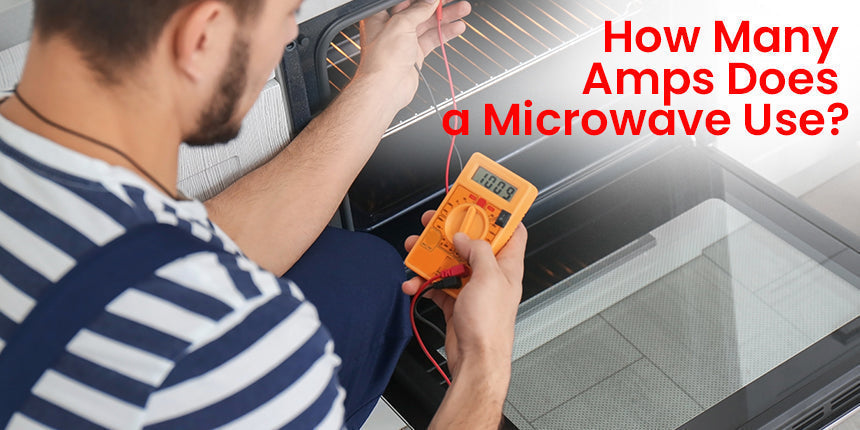
An electrician can measure current with a clamp meter. This is the safest choice for built-in units or circuits that are difficult to access. Do not open the microwave case. Microwaves contain high-voltage parts that can remain dangerous even after the appliance is unplugged.
For everyday planning, the label is usually enough. The goal is not to measure the appliance every time you heat leftovers. The goal is to know whether the circuit can safely handle the load.
Source: jackery.com
Microwave Energy Use and Cost
Amps describe electrical current, but they do not tell you the full cost of using a microwave. Energy use is measured in kilowatt-hours, or kWh.
Use this formula:
Kilowatt-hours = Watts ÷ 1,000 × Hours Used
Suppose a microwave uses 1,200 watts and runs for 10 minutes:
1,200 ÷ 1,000 × 0.167 hours = about 0.20 kWh
If electricity costs 18 cents per kWh, that 10-minute use costs about 4 cents.
Microwaves often heat small portions faster than a full-size oven. This can make them useful for reheating food while using less total energy for short tasks. However, energy savings depend on the food amount, cooking time, appliance efficiency, and local electricity price.
Amps and energy use are related but different:
• Amps measure the flow of electricity at a moment.
• Watts measure the rate of electrical power use.
• Kilowatt-hours measure energy used over time.
Understanding this difference makes how many amps a microwave uses easier to discuss without mixing up current, power, and cost.

Source: dinnersdonequick.com
Safety Tips for Microwave Electrical Use
A microwave is convenient, but it is still a high-power appliance. A few simple habits can prevent electrical problems.
• Plug the microwave directly into a properly grounded wall outlet.
• Keep the cord away from hot surfaces and standing water.
• Do not use a damaged cord, cracked plug, or loose outlet.
• Do not run several high-wattage appliances on the same circuit.
• Keep air vents clear so the appliance can cool itself.
• Stop using the microwave if it sparks, smokes, smells hot, or makes unusual sounds.
• Do not remove the outer case or try to repair high-voltage components.
• Follow the installation instructions for over-the-range and built-in models.
A breaker that trips once may result from several appliances running together. A breaker that trips often needs attention. Repeated trips can indicate an overloaded circuit, a wiring problem, or a failing appliance.
The safest approach is to treat electrical capacity like a narrow bridge. One large vehicle may cross safely, but several heavy vehicles at once can create a problem.
Frequently Asked Questions About How Many Amps a Microwave Uses
How many amps does a 1,000-watt microwave use?
A 1,000-watt microwave uses about 8.3 amps on a 120-volt circuit. Its actual input may be higher if the 1,000-watt figure describes cooking output instead of electrical input.
Can a microwave run on a 15-amp circuit?
Yes, many countertop microwaves can run on a 15-amp circuit. Check the input rating and avoid running other high-power appliances on the same circuit.
Does a microwave use more amps when it starts?
A microwave can have a brief starting surge, but normal running current is usually the more useful number. If the breaker trips at startup, the circuit or appliance should be checked.
How many amps does a 700-watt microwave use?
A 700-watt microwave may use about 8 to 10 amps if its input power is around 1,000 to 1,200 watts. Check the rating label because cooking watts and input watts are not always the same.
Can I use a microwave with a power strip?
It is best to plug a microwave directly into a grounded wall outlet. Many power strips and extension cords are not designed for the sustained load of a microwave.
Why does my microwave keep tripping the breaker?
The circuit may be overloaded, the outlet or wiring may have a fault, or the microwave may be defective. Unplug other appliances and stop using the microwave if the breaker continues to trip.
Conclusion
Most US microwaves use about 5 to 15 amps, with many common models drawing around 8 to 13 amps on a 120-volt outlet. The best answer comes from the input rating label, not only the cooking wattage printed on the front.
Use the formula amps = watts ÷ volts, avoid sharing the circuit with other high-power appliances, and never ignore heat, sparks, odors, or repeated breaker trips. Check your microwave’s label today, compare its rating with the circuit, and consult a qualified electrician if anything seems unsafe.