Does Goodwill Take Microwaves: Donation Guide And Tips
Introduction
Goodwill may take microwaves, but acceptance rules vary by store and region. Many U.S. Goodwill locations accept clean, working countertop microwaves. Some do not accept them because of local safety rules, limited testing space, storage limits, or disposal costs.
Before you load a microwave into your car, call the exact Goodwill store or donation center. Ask if it accepts working countertop microwaves and whether it has any size, age, or condition limits.
Does Goodwill Take Microwaves?
Goodwill does not have one nationwide rule for every donated item. Local Goodwill organizations set their own donation policies. That means one store may accept a microwave while another nearby store may refuse it.
In general, a Goodwill store is more likely to accept a microwave when it is:
- Fully working
- Clean and free of strong odors
- Complete, with its glass tray and turntable ring
- Safe to plug in and use
- Free of rust, sharp edges, smoke damage, or broken parts
- A small countertop model rather than a built-in unit
Goodwill stores often sell donated goods to support job training and community programs. A microwave must have enough resale value to justify transport, inspection, storage, and testing.
What Goodwill may refuse
A store may reject a microwave that has:
- A broken or loose door
- Cracked glass
- Exposed wires
- Burn marks or a strong smoke smell
- Heavy grease or food buildup
- Severe rust inside the cooking area
- A missing glass plate
- A missing turntable ring
- A damaged power cord or plug
- Signs of sparks, arcing, or overheating
- A built-in design that requires installation
- An unknown safety problem
Do not donate a microwave that is unsafe to operate. Goodwill employees may not be able to repair or safely dispose of every appliance that arrives at a donation center.
How to Check Whether Your Local Goodwill Accepts a Microwave
The most reliable answer comes from the specific Goodwill location that will receive the appliance. Goodwill organizations operate by region, so a policy listed on one local website may not apply to another store.
Use this process:
- Find the nearest store or donation center through the Goodwill locator.
- Call before you travel.
- Ask whether the location accepts working microwaves.
- Describe the microwave as countertop, over-the-range, or built-in.
- Explain any known issue, such as a missing tray or cosmetic damage.
- Ask whether it accepts the item during the current donation hours.
- If the store refuses it, ask whether it recommends a local recycling or appliance program.
A simple call script is:
“Hi, do you accept clean, working countertop microwaves? It is a [brand and model], and it includes the glass tray and turntable ring. Are there any size or condition rules I should know about?”
This approach can save you a wasted trip. It also gives the store a chance to explain rules that may not appear online.
What Kind of Microwave Is Goodwill Most Likely to Accept?
The type of microwave affects the answer. A small countertop unit is usually easier to inspect, move, display, and resell than a built-in appliance.
| Microwave type | Likely donation outcome | Why |
|---|---|---|
| Working countertop microwave | Often accepted, depending on location | Easy to move and use |
| Large countertop microwave | Ask first | May exceed store space or handling limits |
| Over-the-range microwave | Often requires advance approval | It may need installation and may be heavy |
| Built-in microwave | Less likely to be accepted | Removal and installation can be difficult |
| Broken microwave | Usually refused | It has little resale value and may need special disposal |
| Microwave with missing parts | Ask first | The store may not be able to sell it safely |
| Commercial microwave | Location-dependent | It may be too large or specialized |
An over-the-range microwave can also include a fan, light, mounting hardware, and electrical requirements. Even if the unit works, a donation center may not have a safe way to handle or resell it.
If you are replacing a built-in or over-the-range model, ask the retailer or installer whether removal or recycling is available. Do not assume a thrift store can accept a heavy appliance.
How to Prepare a Microwave for Donation
A clean, complete microwave has a better chance of being accepted. Preparation also helps protect workers and future users.
1. Unplug it and let it cool
Unplug the microwave before cleaning or moving it. If you recently used it, let it cool first.
Never move a microwave by pulling on its cord. Lift it from the bottom, and ask for help with large or heavy models.
2. Clean the inside
Remove the glass tray and turntable ring. Wash them with warm, soapy water if the manufacturer allows it.
Wipe the inside with a damp cloth and mild soap. Remove grease, food pieces, and loose debris. Do not pour water into vents, controls, or openings.
Avoid harsh abrasives that can damage the interior coating. Do not scrape forcefully at rust or peeling surfaces.
3. Clean the outside
Wipe the door, handle, control panel, top, and sides. Remove stickers that contain personal information, such as a name or address.
Do not use a soaked cloth near the control panel or power cord. Moisture can damage electrical parts.
4. Check the key parts
Confirm that the microwave has:
- The glass cooking tray
- The turntable support or ring
- A secure door
- A working control panel
- An intact power cord
- No loose pieces inside the cooking area
If the microwave has a removable charcoal or grease filter, check the owner’s manual. A missing filter may not prevent donation, but it can affect the unit’s value and safe use.
5. Test it only if it appears safe
If the cord, plug, door, and housing look sound, you can run a brief test with a microwave-safe cup of water. Use the manufacturer’s instructions and stop if you see sparks, smell burning, hear unusual sounds, or notice smoke.
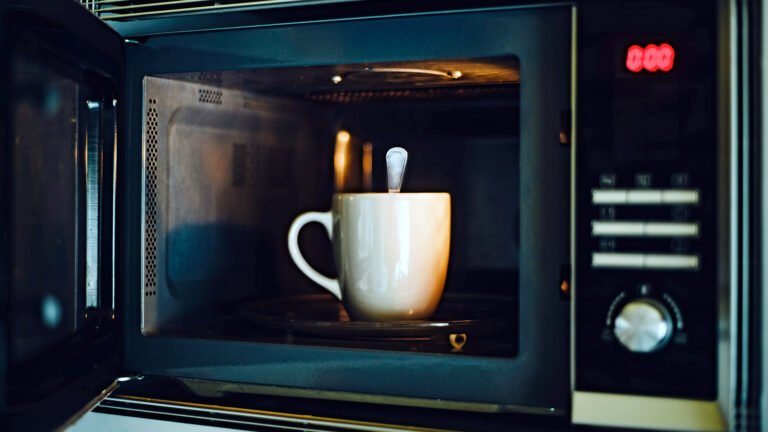
Never run an empty microwave. Metal objects, foil, metallic trim, and unsuitable containers can cause arcing or damage.
Testing is not required if the microwave shows damage. In that case, do not plug it in.
6. Pack loose parts with the unit
Place the glass tray and turntable ring inside the microwave or secure them safely beside it. Tell the donation worker about any missing manual, cosmetic damage, or known limitation.
Should You Donate, Sell, or Recycle the Microwave?
The best option depends on the microwave’s condition, age, size, and local rules.
Donate it when it works and is complete
Donation makes sense when the microwave is clean, safe, and useful. Call Goodwill first, since acceptance is not guaranteed.
Other U.S. donation options may include:
- Local thrift stores
- Habitat for Humanity ReStore locations
- Community centers
- Shelters
- Mutual-aid groups
- Places of worship
- Local reuse programs
Each organization has its own rules. Confirm acceptance before delivery.
Sell it when it has strong resale value
A newer, clean microwave may sell through a local marketplace. Include:
- Brand and model
- Approximate age
- Capacity, if known
- Wattage, if listed
- Dimensions
- A clear photo of the inside
- Any known flaw
Be honest about its condition. A buyer should know if the turntable is missing, the keypad has worn labels, or the door has cosmetic damage.
Recycle it when it is broken or unsafe
A microwave contains metal, plastic, glass, and electronic parts. Do not place it in curbside recycling unless your local program specifically accepts microwaves.
For recycling options, check:
- Your city or county waste department
- Your local solid-waste district
- A household hazardous-waste program
- An electronics recycling event
- A retailer’s appliance recycling service
- Earth911’s recycling search tool
The U.S. Environmental Protection Agency recommends checking local programs because accepted items and collection methods differ by community.
Some recycling centers charge a fee. Ask about charges, drop-off rules, and whether the program accepts microwave ovens before you go.
Common Mistakes to Avoid
Do not leave it outside the donation door
An unattended appliance can become a safety hazard and may be treated as illegal dumping. Use the store’s staffed donation area during posted hours.
Do not hide damage
Tell the donation worker about faults or missing parts. A microwave that sparks or has a damaged door should not be passed to another person.
Do not assume every Goodwill has the same policy
Goodwill is a network of local organizations, not one single store system with identical donation rules. Policies can differ by city, region, and facility.
Do not donate a built-in unit without asking
A built-in or over-the-range microwave may need special handling. It can be heavy, difficult to install, or unsuitable for a general thrift store.
Do not use a microwave with a damaged door
The door and its seal are key safety parts. Do not use or donate a microwave with a door that does not close correctly, has broken glass, or has damaged hinges or latches.
Do not put it in curbside recycling without checking
Many curbside programs do not accept large appliances or electronic devices. Follow your local waste authority’s instructions instead.
Quick Decision Guide
Use this short guide before choosing what to do:
- It works, is clean, and is complete: Call Goodwill and ask about donation.
- It works but is large or built-in: Call first; a reuse or appliance program may be better.
- It has minor cosmetic wear: Ask Goodwill. Cosmetic wear does not always prevent acceptance.
- It is missing the tray or ring: Ask before taking it in.
- It sparks, smells burned, or has a damaged door: Do not donate it for reuse. Ask about recycling.
- It is badly stained, greasy, rusty, or damaged: Recycling may be more suitable.
- You are unsure whether it is safe: Do not plug it in. Contact a qualified appliance service provider or local recycling program.
Frequently Asked Questions
Does Goodwill accept broken microwaves?
Usually, a Goodwill store is less likely to accept a broken microwave because it cannot sell the item as a working appliance. Local rules differ, so call the store before visiting. For a microwave with electrical damage, a broken door, smoke damage, or sparking, use a local appliance or electronics recycling program instead.
Does Goodwill take microwaves without the glass plate?
Some locations may accept one, but a missing glass plate can make the microwave harder to sell and use. Call first and describe the missing part. Do not substitute a random plate unless it is made for that model and fits correctly.
Can I donate an over-the-range microwave to Goodwill?
You should ask before bringing one. Over-the-range and built-in microwaves are heavy and may require special mounting or electrical work. Goodwill may refuse them even when they work. A retailer, installer, appliance reuse group, or recycling center may be a better option.
Does Goodwill pick up microwaves?
Pickup services vary by local Goodwill organization. Some locations offer pickup for large donations, while others do not accept individual small appliances for pickup. Contact the local organization and ask about minimum donation size, fees, service areas, and appliance rules.
Can I put a microwave in the trash?
Local disposal rules control the answer. Some communities allow microwaves in regular trash, while others require appliance or electronics recycling. Check your city or county waste department before putting one at the curb. Never leave it beside a donation center after hours.
Key Takeaways
- Goodwill may accept a microwave, but each local store sets its own rules.
- Working, clean, complete countertop models are the best candidates.
- Call the exact Goodwill location before transporting the appliance.
- Do not donate a microwave with a damaged door, exposed wires, sparks, smoke damage, or a serious burn smell.
- Built-in and over-the-range models need special approval.
- If Goodwill refuses the microwave, check local reuse, appliance, or electronics recycling programs.
Conclusion
Goodwill can take microwaves in some U.S. locations, but acceptance depends on the local organization and the appliance’s condition. A clean, working countertop microwave has the strongest chance of being accepted.
The best next step is simple: find the nearest Goodwill donation center, call ahead, and describe the microwave accurately. If it is broken or unsafe, skip donation and use your local appliance or electronics recycling option instead.