
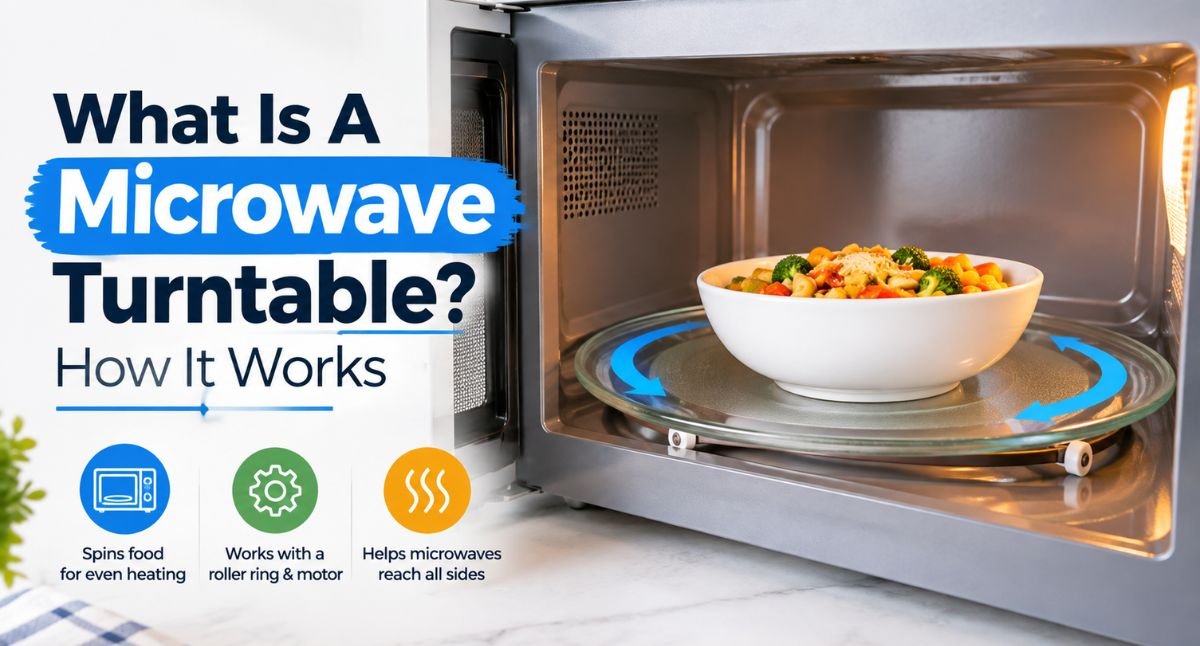
What Is A Microwave Turntable: How It Works
A microwave turntable is a rotating glass tray that helps food heat more evenly inside the oven.
If you have ever found a cold spot in the center of a hot meal, you have seen why this small part matters. Understanding what is a microwave turntable, how it works, and how to care for it can help you heat food safely, choose the right replacement, and avoid costly damage.
What Is a Microwave Turntable?
A microwave turntable is the round tray inside a microwave oven that rotates while food cooks. Most turntables are made from heat-resistant glass. They sit on a roller guide and connect to a small motor under the oven floor.
The main purpose of a microwave turntable is to move food through the microwave’s energy field. Microwaves do not heat every spot in the oven equally. Rotation helps expose different parts of the food to areas with more microwave energy.
In simple terms, the turntable works like a slow carousel. Instead of leaving one part of a meal in a hot spot, it moves the meal around the oven cavity. This helps reduce uneven heating, though it does not guarantee that every bite will reach the same temperature.
The answer to what is a microwave turntable also includes its support parts. A complete turntable system usually has:
• A glass cooking tray
• A roller ring or support guide
• A center hub, coupler, or drive socket
• A small motor beneath the oven floor
Some microwaves use a rotating plate, while others use a flat-bottom design with a hidden stirrer. However, the glass tray is the most familiar type in homes across the United States.

How Does a Microwave Turntable Work?
To understand what is a microwave turntable, it helps to look at the basic heating process. A microwave produces electromagnetic energy through a component called a magnetron. This energy enters the cooking space and causes certain molecules, especially water molecules, to move.
That movement creates heat. Yet the energy does not spread perfectly across the oven. Some areas receive more energy than others because of the oven’s shape, metal walls, and the way waves reflect inside the cavity.
The microwave turntable helps solve this problem in four simple steps:
- The microwave creates energy.
- The energy reflects around the cooking cavity.
- The tray motor slowly rotates the food.
- Different parts of the food pass through different energy zones.
The turntable does not make the microwave more powerful. It does not increase the wattage or shorten cooking time by itself. Its job is to improve exposure and support more even heating.
Most turntables rotate at a slow speed. The exact speed varies by model, but the movement is usually steady and gentle. This allows food to stay centered while the tray turns.
A turntable may also help prevent one section of food from overheating. For example, a frozen dinner may have a warm edge and a cold center after one cycle. Rotation can reduce that difference, but stirring and standing time are still important.

Source: amazon.com
Why Do Microwaves Have Turntables?
The main reason is uneven microwave distribution. The answer to what is a microwave turntable is not complete without explaining this benefit.
Microwave energy forms patterns inside the oven. These patterns can create hot spots and cool spots. A stationary bowl may remain in one position and absorb energy unevenly. A rotating tray moves the bowl through several zones.
A turntable can help with:
• More even heating
• Fewer cold areas in food
• Better heating of leftovers
• More consistent melting
• Improved cooking results for many microwave meals
Still, the turntable is only one part of the process. Food shape, moisture, density, container size, and cooking time also affect the result.
For example, soup often heats well because it contains a lot of water and can be stirred. A thick casserole may heat less evenly because the center warms more slowly than the edges. A turntable helps, but covering, stirring, and resting the food often help more.
The U.S. Food and Drug Administration advises users to follow the cooking directions for packaged foods and allow standing time when instructed. Standing time lets heat continue moving through the food after the microwave stops.

Source: recpro.com
What Parts Make Up a Microwave Turntable System?
When people ask what is a microwave turntable, they often mean the glass plate. However, the full system has several parts that work together.
Glass Tray
The glass tray is the removable plate that holds the food. It usually has a raised rim and a center shape that matches the drive coupler.
Microwave trays are made for repeated heating, but they can still break. A sudden temperature change may cause thermal shock. For example, placing a very cold tray into a hot sink can increase the risk of cracking.
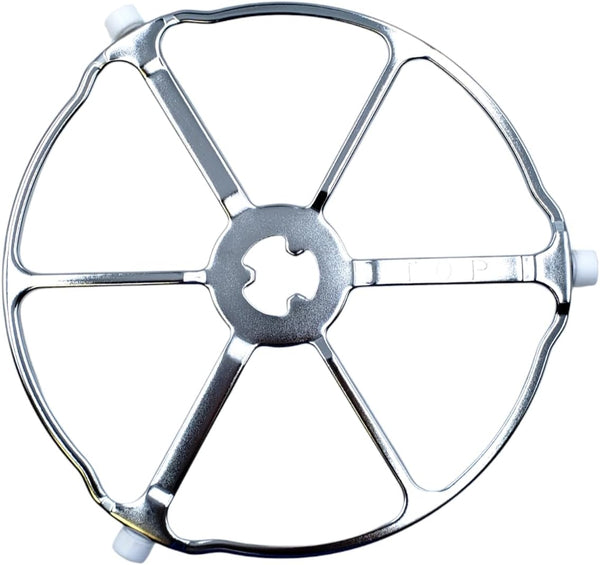
Roller Ring
The roller ring sits below the glass tray. It has small wheels that let the tray move smoothly.
A dirty or damaged roller ring may cause:
• Loud clicking
• Wobbling
• Slow movement
• Scraping sounds
• A tray that stops turning
Cleaning the ring often solves simple movement problems. Food crumbs can block the wheels or make the tray sit unevenly.
Drive Coupler
The drive coupler is the small part that connects the tray to the motor. It may have a three-sided, star-shaped, or other custom design.
If the coupler is cracked or worn, the glass tray may not turn even when the motor works. This part is often easy to replace, but it must match the microwave model.
Turntable Motor
The motor sits below the oven cavity. It turns the coupler and tray at a slow speed.
A motor problem may cause the tray to stop, turn irregularly, or make a humming sound. Because the motor connects to electrical parts, unplug the microwave before inspecting anything beyond the removable tray and roller ring.

Source: amazon.com
What Happens If the Microwave Turntable Does Not Rotate?
A microwave can often heat food even when the tray does not turn. However, the food may heat less evenly. This is especially noticeable with large portions, dense meals, and foods that cannot be stirred.
If you are trying to understand what is a microwave turntable because yours has stopped working, start with simple checks:
- Unplug the microwave.
- Remove the glass tray and roller ring.
- Clean the oven floor and wheel tracks.
- Check for cracks in the tray.
- Make sure the coupler is seated correctly.
- Reinstall the roller ring and tray.
- Confirm that the tray sits level.
- Test the microwave with a microwave-safe cup of water.
Never run an empty microwave for testing. Heating an empty cavity can damage the oven because there is no food or liquid to absorb the microwave energy.
If the tray still does not move, the cause may be a faulty motor, coupler, wiring connection, or control system. Do not remove the microwave cabinet unless you are trained to work with high-voltage appliances. A microwave can hold a dangerous electrical charge even after it is unplugged.
In many cases, you can continue using the microwave for short periods by stopping to stir or rotate the food manually. This is a temporary workaround, not a full repair.

Source: amazon.com
Can You Use a Microwave Without a Turntable?
Yes, but the result may be less even. The answer to what is a microwave turntable shows why rotation is useful, but not every microwave depends on it.
Some models are designed with a flat ceramic floor. These ovens use a hidden rotating antenna, stirrer, or energy-distribution system instead of a visible glass plate. You should never add a turntable to a microwave that was not designed for one.
If a turntable model stops rotating, you can still heat food with extra care:
• Use a round, microwave-safe container.
• Place food near the center.
• Stir food during cooking when possible.
• Rotate the container by hand halfway through heating.
• Let food stand before eating.
• Check the temperature in more than one spot.
For safety, leftovers and other ready-to-eat foods should reach 165°F when reheated, according to U.S. food safety guidance. Use a food thermometer when the food contains meat, poultry, seafood, eggs, or other high-risk ingredients.
A microwave without a working turntable is not automatically unsafe. The main concern is uneven heating. Cold areas may remain when other parts are hot, which can be a food safety issue.
Source: lgparts.com
How to Clean and Maintain a Microwave Turntable
Proper care can extend the life of the turntable system. In practical use, the most common problems come from food buildup, poor tray placement, and rough handling.
Follow these steps:
- Unplug the microwave if you are cleaning around the bottom drive area.
- Remove the glass tray and roller ring.
- Wash the tray with warm water and mild dish soap.
- Wipe the roller ring and its wheels.
- Clean the oven floor with a soft cloth.
- Remove stuck food before reinstalling the parts.
- Dry all parts well.
- Place the roller ring in its track.
- Align the tray with the center coupler.
Avoid pouring water into the center drive opening. Moisture inside the lower mechanism may cause electrical or mechanical problems.
Do not use harsh scouring pads on the glass tray. Small scratches can weaken glass over time. Also avoid placing a hot tray on a cold stone counter or under cold water. Let it cool first.
A simple habit helps prevent many issues: lift the tray out instead of sliding it across the oven floor. This protects the roller ring, coupler, and glass surface.

Source: amazon.com
How to Choose a Replacement Microwave Turntable
If your tray is cracked or missing, do not guess based only on its diameter. Knowing what is a microwave turntable helps you understand why several measurements matter.
Check these details before ordering:
• Microwave brand and model number
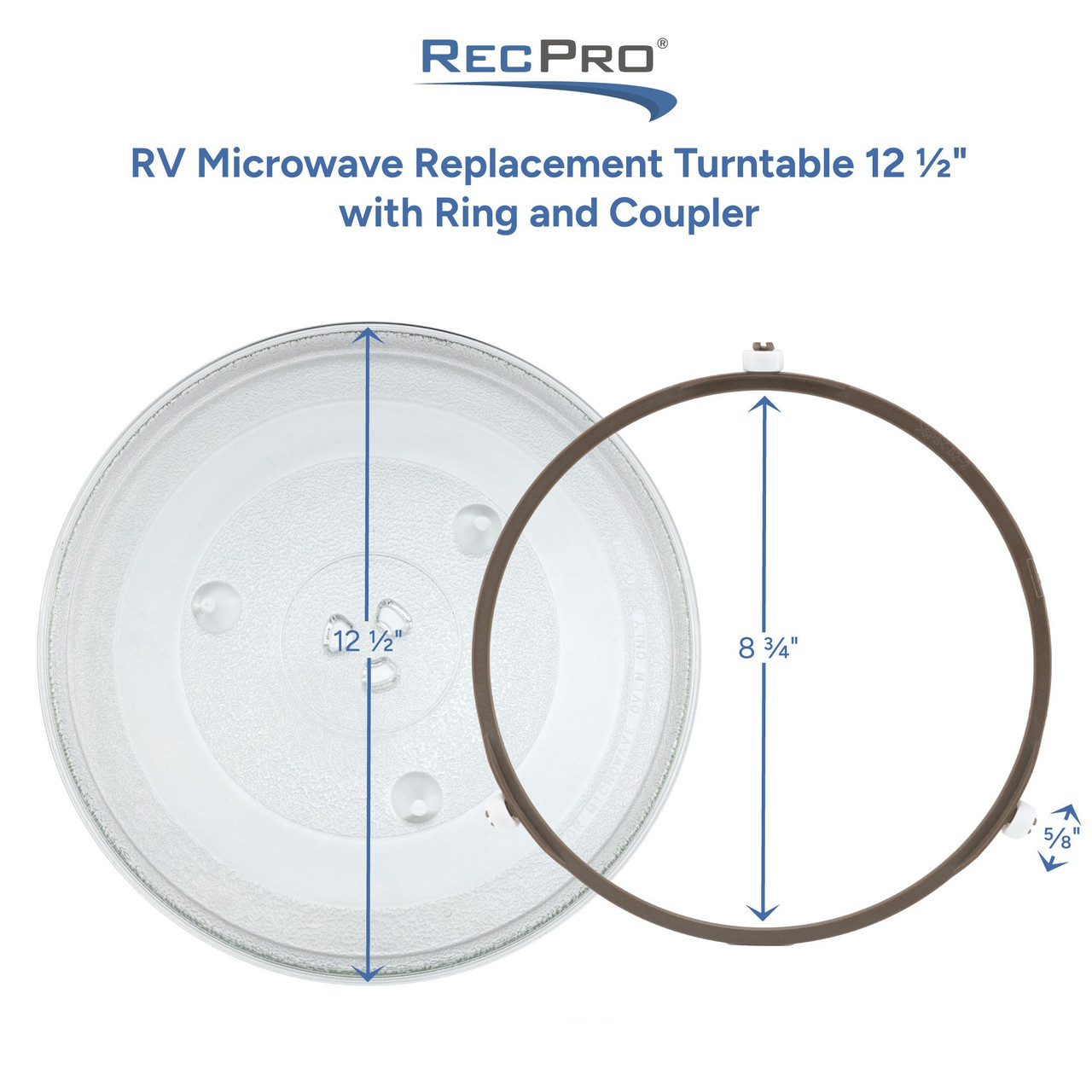
• Tray diameter
• Center hub shape
• Number and position of tray guides
• Tray rim style
• Maximum weight rating, when listed
Measure the old tray from edge to edge. Then inspect the center connection. Two trays may have the same diameter but different hub designs.
The model number is usually found on a label inside the door frame, on the back, or on the side of the control panel. Use that number to find a compatible replacement through the manufacturer or a trusted appliance-parts seller.
Do not use a random glass plate as a substitute. A tray that is too large may touch the walls. A tray with the wrong center design may not rotate properly. A plate without the right support points may wobble or fall.
If the original tray is unavailable, a universal replacement may work. Confirm its measurements and hub design before purchase. When in doubt, compare the replacement part number with the microwave’s manual.
Source: recpro.com
Common Microwave Turntable Problems and Fixes
Learning what is a microwave turntable can make basic troubleshooting easier. Many issues do not require a major repair.
The Tray Does Not Turn
First, check whether the microwave has a turntable on/off setting. Some models let users stop rotation for large or rectangular dishes.
If no setting is involved, inspect the roller ring, coupler, and tray alignment. A worn motor may need professional replacement.
The Tray Wobbles
A wobbling tray may have a cracked center, a bent roller ring, or food buildup under one wheel. Clean the parts and check that the tray sits firmly on the guides.
Replace damaged parts rather than placing a towel or object under the tray. Improvised supports can block movement and create a safety risk.
The Microwave Makes a Grinding Sound
Grinding may come from a dirty roller ring or a damaged coupler. Stop using the microwave if the noise is loud, sudden, or paired with sparks or a burning smell.
The Glass Tray Cracks
A cracked tray should be replaced. Do not use glue or tape to repair it because heat, moisture, and movement can make the damage worse.
The Tray Turns but Food Stays Cold
The turntable cannot fix every heating problem. Check the power level, cooking time, food density, and container. If the microwave also produces unusual sounds or weak heating, contact a qualified technician.
Microwave Turntable Safety Tips
The answer to what is a microwave turntable should always include safe use. The tray moves during cooking, so poor placement or damaged parts can create avoidable problems.
Keep these tips in mind:
• Use only containers labeled microwave-safe.
• Keep food and containers away from the oven walls.
• Do not operate the microwave when the glass tray is cracked.
• Do not run the microwave empty.
• Never place metal on a standard microwave turntable unless the manual specifically allows it.
• Do not force the tray to rotate by hand while the microwave is running.
• Stop using the appliance if you see sparks, smoke, or electrical damage.
• Stir food and check its temperature before serving.
• Use oven mitts for hot containers and trays.
• Keep children away from hot food and steam.
Do not assume that a rotating tray means the food is ready. Microwave heating can be uneven, especially in thick foods. A short rest period helps heat spread from warmer areas into cooler areas.
Also remember that steam can burn. Pierce foods with skins, such as potatoes, and open covered containers carefully. Follow the instructions on packaged meals and use a lower power setting when the food needs gentler heating.
Turntable Versus Flatbed Microwave Design
A turntable microwave uses a moving glass tray. A flatbed microwave has no visible rotating tray and uses a different system to spread energy.
Both designs can work well. The best choice depends on your space, cooking habits, and cleaning preferences.
Turntable Benefits
• Proven and common design
• Usually simple to understand
• Helps move food through energy zones
• Replacement trays are widely available
Flatbed Benefits
• More usable floor space
• Better for large rectangular dishes
• No glass tray to crack
• Easier access for some users
A flatbed does not automatically heat food more evenly than a turntable model. Performance depends on the microwave’s design, power, controls, and cooking instructions.
A turntable can also be easier to repair because its parts are visible and replaceable. However, its glass tray takes up some space and can break if dropped.
Frequently Asked Questions About What Is a Microwave Turntable
What is a microwave turntable used for?
A microwave turntable rotates food during heating. This movement helps expose different parts of the food to areas of microwave energy, which can reduce hot and cold spots.
Does a microwave need a turntable to work?
No. Some microwaves use a flatbed design with another method of spreading energy. A turntable microwave may still heat without rotation, but the food may heat less evenly.
Can I use my microwave if the turntable is broken?
You can use it for short periods, but you should stir, rotate, and check the food carefully. Replace the damaged tray or repair the rotation system as soon as possible.
Are microwave turntables universal?
No. Turntables differ in diameter, hub shape, and guide design. Always match a replacement to the microwave model and measure the original tray.
Why is my microwave turntable making noise?
Food debris, a damaged roller ring, a worn coupler, or a failing motor may cause noise. Clean and realign the removable parts first, then seek service if the sound continues.
Can I wash a microwave turntable in the dishwasher?
Some glass trays are dishwasher-safe, but not all are. Check the microwave manual or tray instructions, and let the tray cool before washing it.
How do I measure a microwave turntable?
Measure the glass tray from one outside edge straight across to the opposite edge. Also record the center hub shape and the location of any underside guides.
Conclusion
A microwave turntable is more than a simple glass plate. It is part of a system that rotates food through uneven microwave energy, helping meals heat more consistently.
Now that you know what is a microwave turntable, you can clean it correctly, troubleshoot common faults, and choose a safe replacement. Keep the tray level, avoid sudden temperature changes, and always check food before serving.
Inspect your microwave turntable today, and share this guide with anyone who has a noisy, cracked, or nonmoving microwave tray.
22 Comments